I arrived at the address and honked the horn. After waiting a few
minutes, I honked again. Since this was my last fare for this shift I thought about just driving away, but
instead I put the car in park and walked up to the door and knocked hard.
 "Just a minute," answered a frail, elderly voice. I could hear something being dragged across the floor; after a long pause, the door opened. A small woman who must have been in her 90's stood before me. She was wearing a print dress and an old fashioned pillbox hat with a veil, like somebody out of a 1940's movie.
By her side was a small suitcase. The apartment looked as if no one had lived
in it. All the furniture was covered with sheets. There were no
clocks on the walls, no knickknacks on the shelves or utensils on the counters. In the corner was a cardboard box filled
with photos and glassware.
"Would you carry my bag out to the car young man?" she asked. I took the
suitcase to the cab, then returned to help the woman walk to the cab. She took my arm and we walked slowly toward
the curb; all the while she kept thanking me for my kindness.
"It's nothing," I told her. "I just try to treat my passengers the way I would want my mother to be treated." "Oh, you're such a good boy," she said.
When we got in the cab, she gave me the address she wanted and asked if I
could drive through downtown before we got there? "Ma’am, it's not the shortest way," I
answered.
"Oh, I don't mind," she said. "I'm in no hurry. I'm on my way to a hospice center." I looked in the rear-view mirror. Her eyes were glistening.
"I don't have any family left," she continued in a soft voice. "The
doctor says I don't have very long with all this cancer." (I quietly reached over and shut off the
meter.)
"What route would you like me to take?" I asked.
"Any one you want," she replied. For the next two hours, we just drove through the city. She pointed out a building where she once worked as an elevator operator. Then we drove through a neighborhood where she said she and her husband had lived when they were newlyweds.
She had me pull up and stop in front of an old furniture warehouse that she said had once been a
ballroom where she had gone dancing as a young girl when she was in high school. As we drove, she would often ask me to drive slow in front
of a particular building or around a corner; sometimes she would ask me to just park and then she would stare
into the darkness and say nothing.
At the first hint of sunlight she suddenly said, "I'm tired; can we go to the Hospice Center now?" We drove in silence to the
address she had given me. When we arrived it was a low building, kind of like a small
convalescent home with a long driveway that passed under a portico. As soon as I pulled in, two orderlies came running out. They were solicitous and very intent; they watched her every move. They obviously
were expecting her.
I hopped out and opened the trunk and took her small suitcase to the
door. The orderlies had already seated her in a wheelchair. "How much do I owe you young man?" she asked reaching into her purse.
"Nothing," I answered. "That’s not fair; you have to make a living," she said. "There are plenty if other passengers," I responded.
Almost without thinking, I bent forward and gave her a hug and kissed her on the
cheek. She held onto me tightly. "Young man, you gave an old woman a lot of joy
tonight," she said.
"Thank you," I said as I squeezed her hand and walked back to my cab. Behind me, I heard a center door shut; it sounded like the closing of a life. For the rest of that day, I could hardly talk. I thought what if that woman had gotten an angry cabbie or a driver who was impatient and wanted to end his shift quickly? What if a driver would had refused to take that late night run, or had honked only once, then driven off?
Looking back on last night, I don't think that I have ever done anything
more important in my entire life.
Many of us think our lives revolve around great moments; but the truly great moments in our lives often catch us when we least expect them – they are often hidden in what others consider to be small things.
Remember; people may not always remember what you did for them or what you said to them but I no one ever forgets how you made them feel.
I am not going to ask you to share this story. All I want you to do is think about The Last Cab Ride and remember try to always remember that even though life is not always the party we had always hoped for while we are living it, we might as well dance every chance we get. |
Tuesday, August 18, 2015
THE LAST CAB RIDE ... A Powerful Life Lesson Shared by a Cab Driver


Tuesday, April 7, 2015
The Beauty of a White Rose

I was killing time walking through a Big Bazaar type store, when I overheard a cashier tell a young boy who couldn't have been more than 6 or 7 years old, “Son, I'm sorry, but you don't have enough money to buy this doll.”
The little boy looked at the cashier and asked, “Are you sure?''
The cashier politely took time to count the boy's money again and replied, ''You know that you don't have enough money to buy the doll, dear.'' The little boy looked at the cashier and asked, “Are you sure?''
The little boy stood silent while still holding the doll in his arms. I walked over and asked him who he wished to buy the doll for. “My sister. It is the doll she loved and wanted so much. I wanted to give it to her for her birthday on Friday.”
He went on to say; “I have to have the doll today so I can give the doll to my Mommy tonight so that she can give it to my sister when she goes to live with her tonight. My sister has gone to live with God and Daddy says that Mommy will be going to live with God soon too so I thought Mommy could take the doll with her to give it to my sister on Friday.''
My heart nearly stopped. The little boy looked up at me and said, "I asked my Daddy to tell Mommy to wait until I come back with the doll.” Then the little boy reached in his pocket and pulled out a picture of him laughing with a little girl and said, “I want Mommy to take my picture with her so my sister won't forget me. I don’t want Mommy to leave me, but Daddy says that she has to go to be with my sister." Then he squeezed the doll against his chest as tears fell from his eyes.
I slowly put my hand in my pocket and grabbed a few bills I had and said, "Son, suppose we count your money one more time just in case you do have enough money for the doll?''
"Okay he said. I sure hope I do have enough." As we counted his money, I discreetly added several of my dollar bills to his pile. When we were done counting, low and behold there was enough for the doll and even some money to spare.
The boy looked up and quietly said, "Thank you God for giving me enough money!" Then he looked at me and added, "Last night before I went to sleep I asked God to make sure I had enough money to buy this doll for my sister.” I also wanted to ask him for some money to buy a white rose for my Mommy, but I didn't dare to ask God for that because I thought I would be asking too much. But look what God did. He gave me enough to buy the doll and also enough to buy a white rose for Mommy because she loves white roses."
I finished my shopping with a totally different state of mind from when I started. I couldn't get that little kid out of my mind. As I was checking out, I suddenly remembered a newspaper article from a few days earlier which mentioned a drunken driver hit a car occupied by a young woman and her little girl. The girl died at the scene but the mother was taken to the hospital and was in a critical condition. The family, I recall, was asked to make a decision whether to pull the plug on the life support machine because the woman would not be able to recover from her coma. I wondered if that was the family of the little boy who wanted to buy his sister a doll.
The next day on my way to work I bought a paper. A story featured on the front page was about a young woman who passed late last night because her family had instructed her doctors to pull the plug. I don’t know why but during my lunch break - I went to a nearby florist and bought a dozen white roses and drove to the funeral home that was listed in the paper. The room was full and up front was a casket for family and friends to make their last visit before the burial would occur.
I walked towards the casket and as I neared it I saw a young lady holding a beautiful a white rose in her hand. Next to the rose was a photo of a little boy and a girl laughing and over her chest was placed a doll – a doll I had seen the night before. I immediately turned around and left the funeral home as my eyes filled with tears. On that day I learned the simple beauty of a while rose and a little toy doll.
Thursday, April 2, 2015
Who Was That Man
A nurse on the intensive care ward took the tired and anxious looking serviceman to the bedside. "Your son is here," she said to the old man. She had to repeat the words several times before the patient's eyes opened.

Heavily sedated because of the pain he was experiencing, he dimly saw a young man in uniform standing outside the oxygen tent. He reached out his hand. The young man wrapped his toughened fingers around the old man's limp hand and squeezed a message of love and encouragement.
The nurse brought a chair so the young military man could sit beside the bed. All through the night the young man sat there in the poorly lighted ward, holding the old man's hand and offering him words of love and strength.
Occasionally, the nurse suggested that the young man take a break and go for a walk; however he refused.
Whenever the nurse came into the ward, the uniformed man was oblivious to her and all the other night noises of the hospital - the clanking of the oxygen tank, the laughter of the night staff members exchanging greetings, the cries and moans of the other patients.
Now and then she heard him say a few gentle words to the dying man who said nothing, all he did was hold on tightly to his son's hand all through the night.
Along towards dawn, the old man died. The young man released the now lifeless man's hand he had been holding all night and went to tell the nurse. While she did what she had to do, the young man patiently waited.
Finally, she turned to the young man and started to offer words of sympathy, but the man in uniform interrupted her and asked "Who was that man?"
The nurse was startled, "Why he was your father," she answered.
"No Ma' am', he wasn't my father, "I never saw this man before in my life. My dad is doing fine I just saw him yesterday."
"Then why didn't you say something when I took you into his room?" asked the nurse.
The young man replied "I knew right away there had been a mistake, but I also knew that man needed his son at his side and his son wasn't here.
When I realized he was too sick to tell whether or not I was his son and knowing how much he needed someone to be at his side, I just stayed."
“I came here tonight to find a Mr. William Grey; his son was killed in Iraq today, and I was sent to inform him. What was this gentleman's name?
The nurse, with tears in her eyes, answered, "Son, that was Mr. Grey."
Wednesday, February 11, 2015
The First Presidential Limousine - You Won't Believe It!
It's been a while since I have posted on this blog. December was hectic and January just took off. I am sorry. Hopefully you will find this story fascinating and share it with your family and friends. Gabe

Just hours after Pearl Harbor was attacked on December 7, 1941, the Secret Service found itself with a major dilemma - an unusual problem. President Franklin D. Roosevelt asked to speak to an emergency session of Congress on Tuesday morning, December 9. He chose to wait until Tuesday to address Congress as he wanted as many of the elected state representatives present and wanted to give them time to get back to Washington when he made his address to the nation. This joint session on December the 9th is where he gave his powerful “This is a Day That Will Live on in Infamy” speech.
Though the actual trip from the White House to Capitol Hill was short, Secret Service agents at the time were concerned about his personal safety. Standard vehicles had always been used to transport the President wherever he travelled; however now with the possibility of war pending, they thought a more secure and safer mode of transportation should be used.
Federal Laws in place at the time prohibited government agencies and departments from purchasing vehicles that cost more than $750. The only recourse the Secret Service had was to get emergency authority and funding from Congress to purchase a safer vehicle; however with all the mayhem erupting in Washington, nobody had time for that.
As luck would have it, one of the older (or should we say long-term) agents working for the Secret Service, remembered the US Treasury Department had seized a bulletproof car from a mobster a few years ago that might work.
The mobster they seized the vehicle from was none other than Al Capone - the famous Chicago crime boss. Capone, you may recall, was sent to prison in 1931 for tax evasion. He failed to file and pay taxes on $150,000 of income he earned from his illegal operations. The car the Treasury Department seized from Al Capone was now sitting in a Washington D.C. warehouse.

Capone’s seized car was a 1928 Cadillac Town Sedan which had a V-8 engine.

Interestingly, Capone had his car painted black and green to look identical to the Chicago police vehicles of that era. Capone also had the 1928 Cadillac Town Sedan modified with 3,000 pounds of armor plating and one-inch thick bulletproof glass. Furthermore, he had a police siren and flashing lights installed behind the front grille of the vehicle which he used often to speed his way through Chicago’s congested traffic quickly.

Throughout Sunday night, all day Monday, and all of Monday night mechanics and Secret Service agents labored to clean the car and make sure it was in perfect running condition. On Tuesday morning, December 9, they had Capone’s car ready to transport President Franklin Roosevelt to Capitol Hill.

The point we should all remember from this fascinating little story is: The very first "Official" White House Limousine ever used to transport a US President was a bulletproof Cadillac, formerly owned by the notorious Chicago gangster, Al Capone.
Friday, December 5, 2014
Tuesday, November 11, 2014
One of The Worse Stories We Have To Tell
Many of us, especially those close to my age, can easily remember that terrible disease polio. Several of us saw family members, relatives, neighbors and colleagues afflicted by this terrible illness.
Rotary International, an Organization which I am active in and proud to be a member, has been trying to eradicate this disease from the planet for years. Please take a moment and review the poster below.
Hopefully you will see that there may be a light at the end of this long tunnel and the tragic story may have a happy ending. I know today is Veteran's Day and we should all focus on thanking the Vets we know who served. But maybe tomorrow or the next day, if you see a Rotarian in your community, you might just want to say thanks as well.
Gabe Gabrielsen
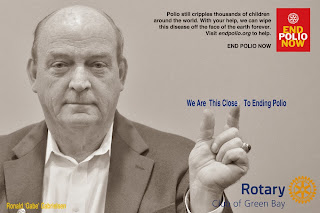
Rotary International, an Organization which I am active in and proud to be a member, has been trying to eradicate this disease from the planet for years. Please take a moment and review the poster below.
Hopefully you will see that there may be a light at the end of this long tunnel and the tragic story may have a happy ending. I know today is Veteran's Day and we should all focus on thanking the Vets we know who served. But maybe tomorrow or the next day, if you see a Rotarian in your community, you might just want to say thanks as well.
Gabe Gabrielsen

Saturday, November 8, 2014
Seven Mentors Who Changed My Life
Warning: Read this story with care. The thoughts I share are not intended for everyone. They are meant for public officials, organizational leaders and career-focused professionals who truly want to make a difference.
I would not have accomplished much in my life had I not followed the advice of seven great mentors. Their insights allowed me to understand my role and overcome the obstacles I confronted.
What they shared allowed me to gain success beyond my wildest dreams. The only regret I have is that I never had the opportunity to personally meet these mentors and thank them for the impact they made on my life.
My first mentor was Nicolaus Copernicus. Copernicus, a Polish monk born in the late 1400’s, stood on the shore to watch a sunset. As the sun set, he realized the earth could not be the center of the universe and he openly challenged the common belief that the earth was the center of the universe. He was ridiculed by his colleagues and chastised by the Church; however, Copernicus remained firm in his convictions. He challenged the status quo and in doing so, he re-shaped the concept of how we view the universe today.
My second mentor was Frederick Taylor. Taylor, a mechanical engineer, always looked for ways to improve organizational efficiencies. Taylor was approached by a coal company that wanted to increase their output of coal. For several days, Taylor sat and observed coal miners; he studied how they dug out the coal and loaded it on the rail cars. Much to the coal mine’s surprise, Taylor recommended every miner be issued smaller shovels with long handles. The coal mine's management laughed - they insisted larger shovels resulted in more coal. Taylor countered saying 25 lb. shovel scoops tire workers out quickly and by mid-morning most were exhausted; however, 15 lb. shovel scoops would not fatigue the miners and they would be able to easily lift 15 lb. shovels full all day - at a brisk pace. His point was give employees the proper tools and they can accomplish more.
Next was my mentor Dale Carnegie. Carnegie, a simple Missouri farm boy, noticed successful leaders share two things in common. First, they know a lot of people and second they feel at ease speaking in public. Carnegie believed “career success” could be accelerated if people would just reach out and meet new people and speak clearly in public.
The fourth mentor who accelerated my career was Evelyn Wood. Evelyn, a high school English teacher, had the wisdom to foresee that more and more of what Americans learned came from books - what they read. She noticed successful people read quickly and retain most of what they read. Her contribution to my career growth was that she created the Evelyn Wood’s Speed Reading Dynamics Course. Her simple course taught people (including myself) how to increase reading speed and improve retention of what was read.
Though not impressed at first, I came to revere Arthur Murray as one of my most influential mentors. Arthur, a draftsman by trade, noticed that successful people had great social skills; none were "wall flowers". He believed careers were limited when people lack social graces – especially dancing skills – yes dancing.
Murray was so passionate about the correlation between good dancing and career success he created a worldwide franchise of dance schools - places where everyday business men and women could learn to dance. People who attended Arthur Murray’s dance schools were able to broadcast their social talent at civic functions. His students included Eleanor Roosevelt, John D. Rockefeller, the Duke of Windsor, prize fighter Jack Dempsey and of course yours truly Gabe Gabrielsen.
My sixth mentor was Elmer Wheeler. Wheeler, an advertising and marketing professional, believed knowledge and experience meant very little if no one bought into your ideas. Elmer coined a phrase "Sell the sizzle – not the steak." He suggested people never wave raw meat in front of a person; show the completed meal - salad, potatoes, dessert and wine.
When a small tire manufacturer in Ohio wanted to go after a share of the global tire market, Mr. Wheeler advised him not to sell tires in their ads. He believed the only way consumers would leave Goodyear and Goodrich and buy his tires was if he would sell the benefits of this new tire. Benefits like "peace of mind", "dependability", and most important, "family safety".
My sixth mentor was Elmer Wheeler. Wheeler, an advertising and marketing professional, believed knowledge and experience meant very little if no one bought into your ideas. Elmer coined a phrase "Sell the sizzle – not the steak." He suggested people never wave raw meat in front of a person; show the completed meal - salad, potatoes, dessert and wine.
When a small tire manufacturer in Ohio wanted to go after a share of the global tire market, Mr. Wheeler advised him not to sell tires in their ads. He believed the only way consumers would leave Goodyear and Goodrich and buy his tires was if he would sell the benefits of this new tire. Benefits like "peace of mind", "dependability", and most important, "family safety".
That small tire manufacturer took Elmer’s advice and today people around the world know that, “Wherever wheels are turning – no matter what the load – the name that’s known is Firestone … when the rubber meets the road, drive a Firestone."
Finally, the mentor with the greatest impact on my career was Dr. David Schwartz. Schwartz, a professor at Georgia State University, sadly realized not all his students would accomplish amazing things. In fact, the vast majority, after graduating, just blended in even though they had stellar academic records and a prestigious degree.
Schwartz concluded only the students who believed they could accomplish big things were the ones who did. Schwartz convinced me to believe in the magic of thinking big. Schwartz never saw the problem as too many chiefs; he saw the problem as too many Indians.
Well, there you have Gabe’s seven mentors and the powerful insights they shared:
1) Challenge the status quo.
2) Give your employees the right tools so they can succeed and accomplish more.
3) Win friends and influence people.
4) Learn to read fast and retain what you read.
5) Exhibit social graces and learn to be a great dancer.
6) Sell the sizzle – not the steak; never dangle unfinished products in front of someone.
7) Think big – and remember, “If you think it can’t be done” … you are right. “If you think it can be done”… you are right.
My hope is that some of you can adopt a few of these sage principals.
Tuesday, October 7, 2014
Should I Take Him Back To The Pound?
I took a new job because I thought it would be good for my career and the pay raise was great, but something was missing. Sure the people I worked with and met on the street were always friendly but when I got home, I always felt some what alone.

One Thursday night I saw a commercial about dogs in the animal shelter and thought maybe a dog would be a good companion for me. So on Saturday morning I went down to the shelter. It was clean and the staff was friendly. After a lengthy discussion about my lifestyle and work schedule, the staff led me to a black Lab called Reggie. They thought Reggie and I would be a good fit and suggested I take him home. They said give him two weeks. If things don’t work out, you can bring Reggie back.
I agreed and so I took Reggie home. They gave me all his things: a dog pad, his water and food dish, a large box of tennis balls and a sealed envelope with a letter from his previous owner enclosed.
I have to admit Reggie and I struggled; we really didn’t hit it off. The problem was he wouldn’t go anywhere without having two tennis balls in his mouth and he would only sometimes follow the commands I gave him - like sit, stay, come and heel. The worst part though was that he never listened when I called his name. I would have to say it four or five times to get him to look in my direction, but then he would go on doing whatever he was doing
After two weeks, I decided I was going to take Reggie back to the shelter. I just knew having him wasn’t going to work out. As I gathered up his things, his pad, the food dishes and all those damn tennis balls, I found that sealed letter the shelter had given me from his previous owner. I sat down on the sofa and opened the envelope. I said, “Okay Reggie, let’s see if your previous owner has any advice to make things work better for us before I take you back to the shelter.” I opened the letter and here is what I read:
“Well, I can’t say that I’m happy you’re reading this letter. I made it clear to the people at the animal shelter that it should only be opened by Reggie’s new owner. If you are reading this, it means you are Reggie’s new owner. I have to tell you Reggie knew something was different when we left for the car ride to the shelter. When I packed up his pad and toys and set them by the back door this morning, he knew something was wrong. And something is wrong . . . which is why I have to try and make it right with this letter.
Let me tell you about Reggie - my wonderful Lab - in the hopes that it will help you bond with him and he with you.
First, Reggie really does love tennis balls. The more the merrier. Sometimes I think he’s part squirrel, the way he hoards them. He usually always has two in his mouth at any time, and he tries to get a third in there. He hasn’t done it yet; and it doesn’t matter where you throw them, he’ll always run after them, so be very careful – don’t throw them near any roads. I made that mistake once, and it almost cost him dearly when he ran out in front of a car.
Next, "Commands". Maybe the shelter staff already told you, but I’ll go over them again: Reggie knows the obvious ones – “sit,” “stay,” “come,” “heel.” He knows hand signals as well. When you put your hand straight up, it means go “back”. If you want him to “roll over”, put your hand out and turn it right or left. If you want a “paw” or “high-five”, put your hand up.
He does “down” when you say down but only if he feels like lying down – I bet you could work with him on that to get it perfect. He knows “ball” and “food” and “bone” and “treat” like nobody’s business. I’ve always trained Reggie with small treats. Nothing gets his attention like little pieces of a hot dog.
The feeding schedule I had him on was twice a day -- once about seven in the morning and again at six in the evening. I gave him regular store-bought food. The shelter should have the brand.
He’s up to date on his shots. Please call the clinic on 9th Street and update his info with your information; they’ll make sure to send you reminders for when he’s due for future checkups. Be fore warned: Reggie really hates the vet. Good luck getting him in the car – I don’t know how he knows when it’s time to go to the vet, but he always knows.
Finally, give him some time. I’ve never been married, so it’s only been Reggie and me for his whole life. He’s gone everywhere with me, so try to include him on your daily car rides if you can. He sits well in the backseat, and he doesn’t bark or complain. He just loves to be around people.
This transition for him may be hard - having to go to live with someone new, so please give him time to adjust. And that’s why I need to share one more bit of info with you . . .
His name’s not Reggie.
I don’t know what made me do it, but when I dropped him off at the shelter this morning I told the staff his name was Reggie. He’s a smart dog and he’ll get used to it and will respond to it. I just couldn’t bear to give them his real name. For me to do that seemed so final. Handing him over to the shelter was as good as me admitting that I’d never see him again. And if I end up coming back, getting him back, and tearing up this letter, it means everything went fine. But if someone else - like you - is reading it, well . . . well it means that his new owner should know his real name. It’ll help you bond with him. Who knows, maybe you’ll even notice a change in his demeanor if he’s been giving you any problems with the name Reggie.
His real name is Tank. Because that is what I drive.
Again, if you’re reading this and you’re from the area, maybe my name has been on the news. I told the shelter that they couldn’t make “Reggie” available for adoption until they received word from my company commander. See, my parents both passed away and I have no siblings - no one I could have left Tank with . . . and it was my only real request of the Army upon my deployment to Afghanistan, that they have someone make one phone call to the shelter . . . in the “event” . . . to let the shelter staff know that Tank could be put up for adoption.
Luckily, my squad leader is a dog guy and he said if anything happened to me, he would personally make the call to the shelter. And if you’re reading this letter, then he made good on his word; he called the shelter and told them I would not be coming back for Tank.
Well, this letter is getting too downright depressing, even though I’m just writing it for my dog. I couldn’t imagine if I was writing this letter for a wife or kids, but Tank has been my family for the last six years, almost as long as I have been in the Army.
I hope and pray that you will make Tank part of your family; I am sure he will adjust and come to love you the same way he loved me. That unconditional love I got from Tank is what I am taking with me. His love is an inspiration for me to do something important, to protect innocent people from those who would do terrible things to America . . . and to keep those terrible people from ever coming over here. If I had to give up Tank in order to do that, then I am glad to have done so.
All right, that’s enough. I deploy this evening and have to drop this letter off at the shelter. I don’t think I’ll say another good-bye to Tank though. I cried too much earlier today the first time I had to say goodbye. Maybe I’ll just peek in on him to see if he finally got that third tennis ball in his mouth.
Good luck with Tank. Please give him a good home, and give him an extra kiss good night – every night – just from me.
Thank you.
Paul Mallory
************
When I finished reading the letter, I looked over at Reggie who was lying on his pad and said, “Tank Come Here.” Tank quickly filled his mouth with "three tennis balls" and ran over to me. He jumped up on the sofa and put his head on my lap. I decided right then = I am not taking Tank back to shelter.
One Thursday night I saw a commercial about dogs in the animal shelter and thought maybe a dog would be a good companion for me. So on Saturday morning I went down to the shelter. It was clean and the staff was friendly. After a lengthy discussion about my lifestyle and work schedule, the staff led me to a black Lab called Reggie. They thought Reggie and I would be a good fit and suggested I take him home. They said give him two weeks. If things don’t work out, you can bring Reggie back.
I agreed and so I took Reggie home. They gave me all his things: a dog pad, his water and food dish, a large box of tennis balls and a sealed envelope with a letter from his previous owner enclosed.
I have to admit Reggie and I struggled; we really didn’t hit it off. The problem was he wouldn’t go anywhere without having two tennis balls in his mouth and he would only sometimes follow the commands I gave him - like sit, stay, come and heel. The worst part though was that he never listened when I called his name. I would have to say it four or five times to get him to look in my direction, but then he would go on doing whatever he was doing
After two weeks, I decided I was going to take Reggie back to the shelter. I just knew having him wasn’t going to work out. As I gathered up his things, his pad, the food dishes and all those damn tennis balls, I found that sealed letter the shelter had given me from his previous owner. I sat down on the sofa and opened the envelope. I said, “Okay Reggie, let’s see if your previous owner has any advice to make things work better for us before I take you back to the shelter.” I opened the letter and here is what I read:
“Well, I can’t say that I’m happy you’re reading this letter. I made it clear to the people at the animal shelter that it should only be opened by Reggie’s new owner. If you are reading this, it means you are Reggie’s new owner. I have to tell you Reggie knew something was different when we left for the car ride to the shelter. When I packed up his pad and toys and set them by the back door this morning, he knew something was wrong. And something is wrong . . . which is why I have to try and make it right with this letter.
Let me tell you about Reggie - my wonderful Lab - in the hopes that it will help you bond with him and he with you.
First, Reggie really does love tennis balls. The more the merrier. Sometimes I think he’s part squirrel, the way he hoards them. He usually always has two in his mouth at any time, and he tries to get a third in there. He hasn’t done it yet; and it doesn’t matter where you throw them, he’ll always run after them, so be very careful – don’t throw them near any roads. I made that mistake once, and it almost cost him dearly when he ran out in front of a car.
Next, "Commands". Maybe the shelter staff already told you, but I’ll go over them again: Reggie knows the obvious ones – “sit,” “stay,” “come,” “heel.” He knows hand signals as well. When you put your hand straight up, it means go “back”. If you want him to “roll over”, put your hand out and turn it right or left. If you want a “paw” or “high-five”, put your hand up.
He does “down” when you say down but only if he feels like lying down – I bet you could work with him on that to get it perfect. He knows “ball” and “food” and “bone” and “treat” like nobody’s business. I’ve always trained Reggie with small treats. Nothing gets his attention like little pieces of a hot dog.
The feeding schedule I had him on was twice a day -- once about seven in the morning and again at six in the evening. I gave him regular store-bought food. The shelter should have the brand.
He’s up to date on his shots. Please call the clinic on 9th Street and update his info with your information; they’ll make sure to send you reminders for when he’s due for future checkups. Be fore warned: Reggie really hates the vet. Good luck getting him in the car – I don’t know how he knows when it’s time to go to the vet, but he always knows.
Finally, give him some time. I’ve never been married, so it’s only been Reggie and me for his whole life. He’s gone everywhere with me, so try to include him on your daily car rides if you can. He sits well in the backseat, and he doesn’t bark or complain. He just loves to be around people.
This transition for him may be hard - having to go to live with someone new, so please give him time to adjust. And that’s why I need to share one more bit of info with you . . .
His name’s not Reggie.
I don’t know what made me do it, but when I dropped him off at the shelter this morning I told the staff his name was Reggie. He’s a smart dog and he’ll get used to it and will respond to it. I just couldn’t bear to give them his real name. For me to do that seemed so final. Handing him over to the shelter was as good as me admitting that I’d never see him again. And if I end up coming back, getting him back, and tearing up this letter, it means everything went fine. But if someone else - like you - is reading it, well . . . well it means that his new owner should know his real name. It’ll help you bond with him. Who knows, maybe you’ll even notice a change in his demeanor if he’s been giving you any problems with the name Reggie.
His real name is Tank. Because that is what I drive.
Again, if you’re reading this and you’re from the area, maybe my name has been on the news. I told the shelter that they couldn’t make “Reggie” available for adoption until they received word from my company commander. See, my parents both passed away and I have no siblings - no one I could have left Tank with . . . and it was my only real request of the Army upon my deployment to Afghanistan, that they have someone make one phone call to the shelter . . . in the “event” . . . to let the shelter staff know that Tank could be put up for adoption.
Luckily, my squad leader is a dog guy and he said if anything happened to me, he would personally make the call to the shelter. And if you’re reading this letter, then he made good on his word; he called the shelter and told them I would not be coming back for Tank.
Well, this letter is getting too downright depressing, even though I’m just writing it for my dog. I couldn’t imagine if I was writing this letter for a wife or kids, but Tank has been my family for the last six years, almost as long as I have been in the Army.
I hope and pray that you will make Tank part of your family; I am sure he will adjust and come to love you the same way he loved me. That unconditional love I got from Tank is what I am taking with me. His love is an inspiration for me to do something important, to protect innocent people from those who would do terrible things to America . . . and to keep those terrible people from ever coming over here. If I had to give up Tank in order to do that, then I am glad to have done so.
All right, that’s enough. I deploy this evening and have to drop this letter off at the shelter. I don’t think I’ll say another good-bye to Tank though. I cried too much earlier today the first time I had to say goodbye. Maybe I’ll just peek in on him to see if he finally got that third tennis ball in his mouth.
Good luck with Tank. Please give him a good home, and give him an extra kiss good night – every night – just from me.
Thank you.
Paul Mallory
************
When I finished reading the letter, I looked over at Reggie who was lying on his pad and said, “Tank Come Here.” Tank quickly filled his mouth with "three tennis balls" and ran over to me. He jumped up on the sofa and put his head on my lap. I decided right then = I am not taking Tank back to shelter.
Tuesday, September 30, 2014
A Truly Fascinating Story For All Business Travelers Who Fly In To or Out Of Chicago's O'Hare Airport
Many years ago, Al Capone, the notorious Chicago gangster, was involved in everything from booze to prostitution to murder. Capone had a personal lawyer nicknamed "Easy Eddie" and Eddie's skill at legal maneuvering was the primary reason Big Al was kept out of jail for so many years.
Capone paid Eddie well and Eddie sure did live the high life. He and his family occupied a fenced-in mansion that filled an entire Chicago city block. Though involved deeply with the mob, Eddie had one soft spot - that was his son whom he loved dearly. Eddie saw to it that his young son "Little Eddie" had the finest clothes, toys, cars and a great good education. Despite his involvement with organized crime, Eddie tried his best to teach Little Eddie right from wrong. Eddie wanted his son to grow up to be a good man.
As the years went bye, Eddie decided to rectify the wrongs he had done and went to the authorities to tell the truth about Al Capone so he could clean up his tarnished name and offer his son some semblance of integrity. Eddie knew the cost for testifying against the mob would be great ... and he was right. Within less then a year, Easy Eddie's life ended in a blaze of gunfire on a lonely Chicago side street. But in his eyes, Eddie gave his son a great gift.
Capone paid Eddie well and Eddie sure did live the high life. He and his family occupied a fenced-in mansion that filled an entire Chicago city block. Though involved deeply with the mob, Eddie had one soft spot - that was his son whom he loved dearly. Eddie saw to it that his young son "Little Eddie" had the finest clothes, toys, cars and a great good education. Despite his involvement with organized crime, Eddie tried his best to teach Little Eddie right from wrong. Eddie wanted his son to grow up to be a good man.
As the years went bye, Eddie decided to rectify the wrongs he had done and went to the authorities to tell the truth about Al Capone so he could clean up his tarnished name and offer his son some semblance of integrity. Eddie knew the cost for testifying against the mob would be great ... and he was right. Within less then a year, Easy Eddie's life ended in a blaze of gunfire on a lonely Chicago side street. But in his eyes, Eddie gave his son a great gift.
Now here is an unrelated --- but necessary parallel to the above story ---- please read I promise you won't be disappointed.
World War II produced many heroes. One such man was Navy Lieutenant Commander Butch O'Hare, a fighter pilot assigned to the aircraft carrier Lexington in the South Pacific. One day Butch's squadron was sent on a mission. After he was airborne, Butch looked at his fuel gauge and realized the ground crew did not top off his fuel tank. Butch knew he would not have enough fuel to complete the assigned mission and notified his flight leader who ordered Butch to return to the carrier. Reluctantly, Butch dropped out of formation and headed back towards the fleet.
On returning to the fleet, Butch noticed a squadron of Japanese aircraft off in the distance heading toward the fleet. Since all the fleet’s fighters were out on their missions, the fleet was now virtually defenseless. Though Butch tried to raise his squadron leader on the radio to bring the planes back in time to save the fleet he couldn't.
There was only one thing for Butch do … and that was he had to try and stop the Japanese planes from attacking the fleet by himself. Without hesitation or regard for his personal safety, Butch dove into the formation of enemy aircraft with his wing-mounted 50 caliber's guns ablaze. He attacked one surprised Japanese aircraft after another. Butch wove in and out of the now broken formation and fired shot down as many planes as possible until all his ammunition was finally spent.
Even though his ammo was gone, Butch continued his assault on the Japanese planes by diving at them, trying to clip a wing or hit their vertical tails in hopes of damaging them and rendering them unfit to fly. Totally exasperated, all the remaining Japanese aircraft headed home without even conducting their mission. Tragically Butch ran out of fuel and he and his plane perished in the ocean.
When news of Butch’s heroic efforts reached his home town the towns people unanimously vowed never to allow the memory of this WWII hero to fade from their memory. So they decided to name their city airport in honor of him. That's right the City of Chicago decided to pay tribute to its most courageous native son of WWII.
So for all you travelers who happen to fly in or out of Chicago's "O'Hare Airport" here is my personal recommendation: The next time you find yourself waiting for a flight at O'Hare Airport, give some serious thought to visiting Butch’s memorial - it's located between Terminals 1 and 2. Take a moment and good look at both his statue and his Medal of Honor.
NOW YOU MAY BE ASKING --- GABE WHAT THE HELL DO THESE TWO STORIES HAVE IN COMMON?
Butch the Medal of Honor winner is Edward O'Hare Jr. - the son of "Easy Eddie".
Friday, September 12, 2014
IS IT OKAY TO LIE?
Two elderly men were admitted to a long-term care facility and just by chance were assigned to share a room. One had been involved in a car accident and suffered extensive internal injuries and was not expected live; the other had advanced heart disease and had undergone triple bypass surgery and had a 30% chance of recovery.

The accident victim lost his sight and was restricted to his bed. The heart patient however was required to get out of bed at at 10: 45 each day and walk around the room. So on that first day just before lunch the heart patient painfully placed his feet on the floor.
As soon the blind patient heard his roommate out of his bed he asked, "Would you do me a favor and go to the window and look outside? Please tell me all the wonderful things you see." The heart patient slowly walked toward the window, pulled back the blinds and related the sights he saw. He'd describe the birds and animals playing across the street in the city park then to the delight of his roommate he described all the people walking down the street.
On the second day, the heart patient, while looking out the window noticed the strange actions of a young man who was sitting on the rim of beautiful water fountain not far from an attractive young lady eating her lunch on a park bench.
The next day the heart patient could see the young man on the fountain sat a little closer and it was obvious the woman noticed. Soon they were engaging in conversations. On the fourth day the heart patient saw the couple sharing their lunches and holding hands; he thought perhaps a relationship was about to start.
During that night, the heart patient unexpectedly died from complications and his personal possessions were quickly removed from the room. Early the next morning a new patient, a young man with a broken arm, was moved in.
As lunch time neared the blind man asked his new roommate if he would go to the window and describe what was taking place outside - he particularly wanted to know about the type of birds in the park and what the young couple having lunch by the fountain were doing. The new roommate hopped out of bed and briskly walked over to the window.
He pulled back the blinds, starred for several seconds then began to laugh uncontrollably. "Why are you laughing?" asked the blind patient. "Because you asked me to tell you what was going on outside our window. Our window faces the side of another building and there is nothing we can see but a solid brick wall. There is nothing of interest out there."
The accident victim lost his sight and was restricted to his bed. The heart patient however was required to get out of bed at at 10: 45 each day and walk around the room. So on that first day just before lunch the heart patient painfully placed his feet on the floor.
As soon the blind patient heard his roommate out of his bed he asked, "Would you do me a favor and go to the window and look outside? Please tell me all the wonderful things you see." The heart patient slowly walked toward the window, pulled back the blinds and related the sights he saw. He'd describe the birds and animals playing across the street in the city park then to the delight of his roommate he described all the people walking down the street.
On the second day, the heart patient, while looking out the window noticed the strange actions of a young man who was sitting on the rim of beautiful water fountain not far from an attractive young lady eating her lunch on a park bench.
The next day the heart patient could see the young man on the fountain sat a little closer and it was obvious the woman noticed. Soon they were engaging in conversations. On the fourth day the heart patient saw the couple sharing their lunches and holding hands; he thought perhaps a relationship was about to start.
During that night, the heart patient unexpectedly died from complications and his personal possessions were quickly removed from the room. Early the next morning a new patient, a young man with a broken arm, was moved in.
As lunch time neared the blind man asked his new roommate if he would go to the window and describe what was taking place outside - he particularly wanted to know about the type of birds in the park and what the young couple having lunch by the fountain were doing. The new roommate hopped out of bed and briskly walked over to the window.
He pulled back the blinds, starred for several seconds then began to laugh uncontrollably. "Why are you laughing?" asked the blind patient. "Because you asked me to tell you what was going on outside our window. Our window faces the side of another building and there is nothing we can see but a solid brick wall. There is nothing of interest out there."
Subscribe to:
Posts (Atom)